Projects
Dust Collection Hose Adapters
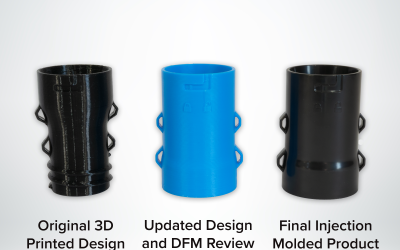
Scaling a 3D printed product with injection molding
The Objective
Convert a family of 3D printed products into injection moldable products.
The Challenge
Shop Nation designs and manufactures miter saw dust collection adapters in a 3D printer farm. Shop Nation also produces a set of adapters to allow end-users to connect their shop vacuum hoses to the dust collectors. Shop Nation wanted to transition the manufacturing of the hose adapters to injection molding to allow their print farm to focus on manufacturing the highly complex dust collection attachments. The original designs of the adapters were optimized for 3D printing rather than injection molding.
The Solution
PDI engineers worked with Shop Nation to update the hose adapter designs to be injection molding-ready. PDI went through several rounds of design optimizations and validation via 3D printing until the customer was satisfied with the updated design.
PDI then coordinated the mold build process with our tooling partners. As with all our new tooling projects, PDI handled the communication and design reviews with the mold builder. After the first article samples were approved, the mold was shipped to PDI for in-house sampling and approval. After dialing in the process settings on our machines, the customer signed off on the products and we began production.
Shop Nation can now focus their efforts on manufacturing their core products, while PDI’s partnership ensures the hose adapters are on hand and high-quality. PDI’s make-to-stock program ensures short lead times and on-time delivery.
Watch Shop Nation / 3D Print Farm Academy’s featuring PDI, on moving from 3D printing to injection molding:
Insert Molded Rubber Bumper (Water Boss)
Scaling an existing product with a new mold and automation
The Objective
Re-tool an existing product with higher cavitation to meet growing demand.
The Challenge
One of PDI’s customers has a single-cavity mold that has been in service for 30 years. The part is insert molded, meaning a brass insert gets placed in the mold before the plastic rubber is molded around the insert. Insert molding often requires hand-loading the insert into the mold, but PDI took on the challenge to automate this process to improve efficiency and throughput.
The Solution
To meet the customer’s cost and throughput goals, PDI commissioned a 4-cavity mold to quadruple the production output. PDI made design choices on the mold to facilitate loading the brass inserts with a robot in the future. Once the mold was built, PDI began running the mold by hand-loading the inserts to get a better idea of the production flow. PDI engineers developed prototype automation concepts to determine the simplest, most cost-effective, and most likely-to-succeed direction.
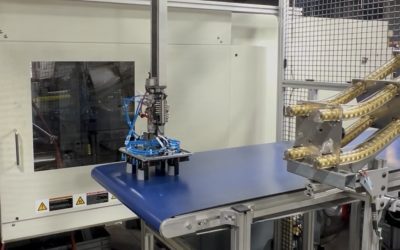
PDI engineers and fabricators developed a gravity slide to position the brass inserts for a robot to pick up 4 inserts at a time. We also developed a robot end-of-arm-tool to remove the finished parts, load the brass inserts in the mold, place the finished parts on a conveyor, and pick up new brass inserts.
The end result is a highly efficient production line, ensuring the customer receives parts on-time and has room to grow for the next 30 years and beyond.
Contact us today to learn more about our in-house automation capabilities.
AgSolutions Drainage Intake
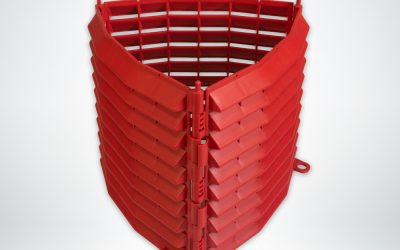
Concept to market for a robust, universal, field drainage intake
The Objective
PDI has an in-house brand of agricultural products, Ag Solutions, which carries a lineup of field drainage and equipment upgrades for farmers in the Midwest and around the country. With so many drainage systems on the market, we sought to develop a “universal” drainage intake which would keep out debris and fit over any existing in-ground inlet.
The Challenge
Several design and manufacturing challenges were present during the 4-year development of the Quick Drain Universal Intake. The parts require strength and durability to stand up to harsh farming environments, and they require complicated structures to enable simple and tool-free assembly in the field.
The Solution
Over the course of several years, PDI engineers designed, prototyped, and iterated on what is now the Quick Drain Universal Intake. We leveraged our design-for-manufacturability expertise to design a product and develop it from concept through production. We began the development by determining the primary product benefits: clog-resistance through our patented drainage concept, easy to assemble without tools, and universal design that can be expandable to meet the customers’ needs.
PDI engineers created design concepts in Solidworks, 3D printed 1:4 scale models of the structure for concept validation, iterated the design, 3D printed full scale models, and tested the completed design. Through this iteration process, we improved the drainage intake qualities and ease-of-assembly before building the mold.
PDI then commissioned the mold to be made by one of our high-quality tooling partners. After producing first articles, we validated that the product met our specifications and launched it on our e-commerce site. The finished product combines injection molded intake panels, a thermoformed lid, and extra-0long ground stakes.
At PDI, we put the same care into ensuring the success of your products that we do for our own. We strive to be not just a supplier, but a manufacturing partner you can count on from product launch throughout production.
Contact us today to learn about how we can partner with your company through your next product launch.
High Volume Shim Production
Utilizing high-tech automation to manufacture window & door shims
The Objective
PDI manufactures tens of millions of shims each year for Glazelock. Production efficiency is paramount to minimize costs, increase profitability, and increase production throughput as Glazelock grows. PDI needed to automate the manufacturing processes to meet production cycle time targets, price targets, and increase annual capacity on a single production line.
The Challenge
Glazelock’s top-selling product line is the ShimStack: peel-apart packs of 8 or 16 shims. In the past, PDI has developed in-house automation cells that weld the parts together in a pack, but it was slow, labor-intensive, and yielded inconsistent quality in the finished product. PDI engineers developed additional prototype automation cells, all which required hand-loading parts into a fixture. The cycle time was still below target, meaning production capacity was limited.
The Solution
PDI engineers went to an automation trade show for inspiration and to make new vendor contacts for automation equipment. PDI met with Epson about their SCARA pick-and-place robots, where Epson was featuring their new low-code programming software. This sparked a new automation concept wherein a pair of robots could handle and process the parts.
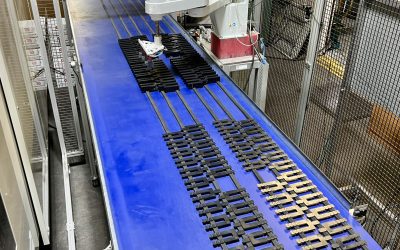
PDI spent about 6 months developing a new automation cell centered around the molding machine-mounted takeout robot and a cost-effective SCARA pick-and-place robot. The automation cell was designed and developed entirely in-house including mechanical, robotics, and PLC integration. This ensured the project remained on-budget and is tightly integrated into our existing infrastructure.
As orders have increased, PDI engineers have made incremental improvements to the automation cell, which now produces over 350,000 parts per day.
PDI tailors production to each customer. If you’re just starting out, we can support prototype tooling to minimize up-front investment while you grow your business. As your company scales and your production needs increase, we’re well poised to grow with you by deploying low-cost automation to save you money.
Read more about this project as featured in an Epson case study.
Contact us today to discuss how we can take your production needs to the next level.